Sunday, May 19, 2013

14 Stations of the Cross

Contemplating the installation with Father David

  After my thesis I had the great opportunity to create the 14 Stations of the Cross for the Church of the Epiphany in Honolulu, thanks to Donald Mtsumori, who has collected my work for many years and has commissioned several portraits and landscapes from me. He is the organist for the church and wanted to create a gift of the stations. The plan was to create black and white wood block prints in order not to compete with the colorful stained glass windows of the church. I carved several blocks and did a lot of test prints, struggling, especially with incorporating the biblical quotations.
I had to put the project aside in order to create work for the Koa Gallery show (see post below. Caution*Righteous*Thirst). In the painting groove, I thought I should try a couple of the stations as paintings. My friend and teacher Stephen Niles had pointed me towards the plywood rounds you can buy at the hardware store. Eventually I ended up stretching linen over the rounds. The project was finished in the fall of 2011 and in December we had a blessing in the church led by Father David Jackson, during which I had the opportunity to talk about the paintings and answer questions.
Below an excerpt from the booklet I put together for the blessing of the stations.

Donald Matsumori and me before the blessing
Thoughts on the Paintings of the 14 Stations

     First of all I like to give thanks to Donald Matsumori, who gave me the opportunity to create these paintings. I also like to thank Father David Jackson and Donald for the trust and patience they had with me during the long process.
     The history of the Stations of the Cross began with pilgrimages to Jerusalem to visit the places of Christ’s life. The desire to follow Christ’s passion at home gave rise to the recreation of the passion as early as the 5th century in Bologna. The word station originates with the English pilgrim William Wey, who visited the holy land in the 15th century. The Franciscans began building out door shrines during the 15th and 16th centuries, which numbered between eleven and thirty. These developed into the ‘traditional’ 14 stations, some of which had no references in the bible.
     On Good Friday 1991 Pope John Paul II introduced a new set of stations, which he called the Scriptural Way of the Cross. He consequently celebrated this form many times.  Pope Benedict XVI approved this set of stations for meditation and public celebration.
They follow this sequence:
 1.   Jesus in the Garden of Gethsemane, 2.   Jesus is betrayed by Judas and arrested, 3.   Jesus is condemned by the Sanhedrin, 4.   Jesus is denied by Peter, 5.   Jesus is judged by Pilate, 6.   Jesus is scourged and crowned with thorns, 7.   Jesus takes up His cross, 8.   Jesus is helped by Simon to carry His cross, 9.   Jesus meets the women of Jerusalem, 10. Jesus is crucified, 11. Jesus promises His kingdom to the repentant thief, 12. Jesus entrusts Mary and John to each other, 13. Jesus dies on the cross, 14. Jesus is laid in the tomb.

     These paintings of the ‘14 stations’ aim to be contemporary, representing my own sensibility and the desire to speak also to the aesthetics of a younger audience. They are cinematic, as they must be, since they tell a story and are inspired by the movie ‘The Passion of the Christ’. The compositions and rendering are my own. When we study the long history of Christian art we discover that the art work is always of its time, yet my hope is that these painting show my respect and debt to all the artist who came before me and are my inspiration. The more than two years of working on this project allowed me to question and reflect on my own spirituality, especially the concepts of self will and surrender 
     The following comments describe my personal relation to these paintings and their story. They do not represent the view of the church and I don’t know if they support or contradict it. My hope is that these thoughts help you to appreciate my work and inspire you on your own spiritual journey.


I.
At night, all is blue, Jesus prays to his father; he sweats and struggles with what is to come. His humanness shows when he asks his father to ‘take this cup away’, yet once he said this, he surrenders with ‘thy will be done’. Jesus tells me to chip away at my ego as well and to surrender to the divine. The stripes remind me of prison-clothing. It also sets up what is to come, which is dark as well as light.
 
II.
 Later the same night Judas reaches up to kiss Jesus in order to identify him to the Roman guards. He has sold his soul, but not everything is as clear-cut as it seems. Judas plays the role of putting the passion into motion. The very moment of this picture can be seen as a hesitation. Is the hand going to reach all the way or is it going to pull back? Do we easily condemn Judas or can we also identify with him in our own doubts and struggles?

  
III.
     Kaiphas, the high priest of the Sanhedrin interrogates Jesus. Again, Jesus is shown with the back to us. Kaiphas is another character for us to recognize ourselves in. Jesus’ actions threaten the Jewish religious aristocracy as well as the beliefs of many people in his time.


IV.
     In fear we do not act true to our selves. Peter is afraid; he doesn’t trust the unfolding of the events and denies Jesus. This, I consider the most ‘classical’ of my paintings of the stations. 

V.
     Crucify him! The crowd actually condemns Jesus, not Pilate, who wants to let him go. Of course the Sanhedrin would like to punish him for questioning their authority, but just like the Rolling Stones sing in ‘Sympathy for the Devil’, “who killed the Kennedys? After all it was you and me.” How quick are we to condemn those who think or are different from us, who threaten us, by daring us to question our beliefs?

VI.
     Now, Jesus passion has begun. The Roman soldiers torture Jesus for being who he truly is. My aim is to pull in the viewer with the close-up composition and the details in the painting. 


VII.
     This is one of two paintings that I did first, about eight month before I started on the entire series. The other one, a close-up of a nail driven through Jesus’ hand, did not make it into the final selection. Both these paintings are rendered straight on wood. All the others are painted on linen stretched on wood. I struggled with applying the paint to the slick wood, even though I had applied three layers of acrylic gesso. The result is thicker paint and rougher brush strokes, a slightly looser approach, since I considered it a ‘test painting’. By the time the series developed to station number seven I decided to keep it. From the pain of the person behind Jesus, to Jesus’ own face, the rawness of his garment, the heaviness of the wooden cross and the bloody hands clinging to the cross, the brush strokes fit the energy of the moment. Finally, the white light on Jesus’ hands point to the potential of transformation.

VIII.
     By the time Simon from Cyrene is pulled into the action involuntarily, Jesus is beaten up severely. In this painting Jesus does not appear heroic. It is Simon through his steady determination, who picks up Jesus and the cross, not just physically. Black, white and red dominate and the cross is blue.

IX.
     Jesus stops to talk to the women of Jerusalem to tell them not to cry for him and that things might even get worse for them in the future. In the painting Jesus talks to one woman standing for all. He holds her chin to make sure that she is completely with him and she is. What I understand here is that Jesus is ok with his lot, since he has completely surrendered his self will. Are we ready to do the same? Are we ready to surrender to the divine within ourselves?

X.
     Jesus is crucified and my initial response to this passage was to paint a close-up of Jesus’ face, extremely damaged with one eye shut, and I did. I lived with these paintings having them hanging above the windows in my living room/studio where I could study them all the time. Something disturbed me besides the realistically rendered brutality of the painting, which was justified for this moment in the story. After contemplating this for a while and considering a different composition, maybe not quite as close, I came to the solution, after reading the bible passage again. The centurion is another character in the story to help us understand that not everything is always as clear-cut as we like it to be. Yes, the Romans brutalized and crucified Jesus, but this centurion has a revelation.

XI.
     I did not paint the good thief. This is the bad thief. After hurling insults he begs to be saved. Isn’t he close to many of us? I personally love this painting. I am not a great fan of heavy metal music, but I call this the heavy metal painting.

XII.
     The mood is blue, but actually I consider this moment as the beginning of the church, hence lots of white. Jesus creates a union between mother and disciple, the beginning of the community that eventually evolves into the church.


XIII.
     Finally Jesus dies. The blurry abstraction invites us to move beyond the suffering of Christ. Death is transformation; the body is no longer the vehicle for our spiritual journey. Jesus last tear drops onto the rocks and explodes in all directions. We are catapulted as well, into the future. What do we take with us from Jesus’ passion?

XIV.
     This painting shows the cloth Jesus was wrapped in when put to rest. I took the liberty to move the story one step ahead. Jesus has already risen and only the cloth is left in the cage, or is it a mountain rising from the desert? I invite the viewer to move beyond the story and the physical presence of Jesus.  The brushstrokes, the folds, ridges, valleys, what do you make of it? Can you fill it with your spiritual longing, can you surrender?

Tuesday, May 14, 2013

CAUTION * RIGHTEOUS * THIRST

overview with superimposed numbers


After finishing my thesis paper I recovered with a series of portraits, mostly of friends. They were all oil on canvas 8" x 10", except one (36" x 36"). They were shown in a group exhibition with Mark Maresca and Calvin Collins, all fellow UH graduate students, at the Koa Gallery in Honolulu (October-November 2010).
Invite with Tatum as Vampire

overview movie during installation

Meredith and me at the reception


Rock'n Roll Baby (Toren)

Shoegazers


Toren playing drums

Actor Michael Greene with granddaughter

Yoga. Myra Lewin teaching Kelsey

Katie eating fries

Jessica as Vampire during spiritweek


Tatum as warrior

Vanessa at Lihue airport

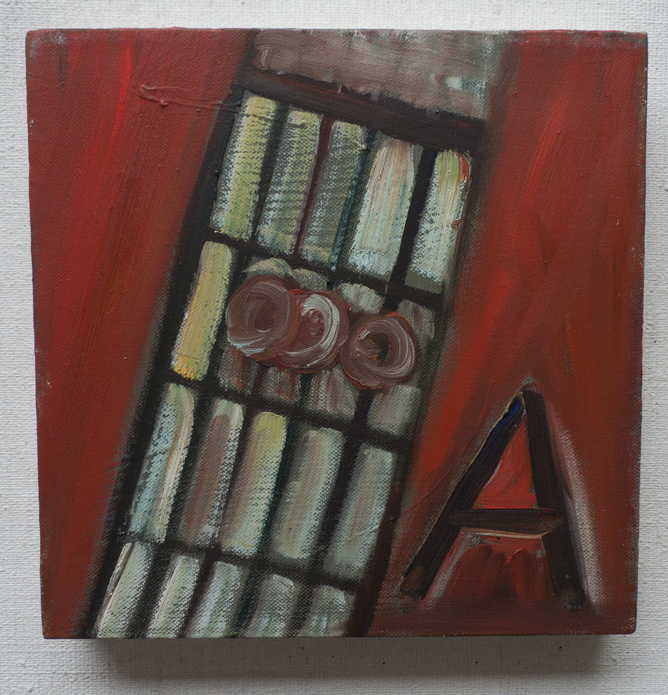
guitarchords paintings


12 chords oil on canvas each 10" x 10"

While I paint I often have a few canvases on the side onto which I make quick, loose paintings with leftover paints, before I clean my palette. This is how the guitar chord paintings came into being.
"learn guitar by painting"


Mystik Mood

Mystik Mood is a black and white movie entirely shot and edited in super 8, old school, by myself. I filmed it while working as a bike messenger. The song was recorded with East of Eden in 1984 and released as a 7" single  Mystik Mood/Sea of Happiness  and on the Dieter Osten /East of Eden 12" album, both on Moon Records.  I wrote Mystic Mood on the roof of 23 St Marks Place, where the VU played at the Electric Circus and where I lived for a while. The video was shown around the world as part of the bicycle film festival (ca 2006/7?).

The video contains parts of a fight between a bike messenger and a cab driver. It happened on my first day of shooting. When I first saw the fight the messenger threw his bike onto the hood of the cab, which started to take off. the messenger grabbed the open rear window of the cab and rode on his heels down the center lane of 5th Ave. I didn't have a battery in my camera yet. I delivered a package to the 10th floor of a building on 41st St and got a battery. Once I returned to 5th Ave I shot the scene in front of the public library. I fills out the guitar solo after the second chorus.
Enjoy!

Mystik Mood DVD cover


http://www.youtube.com/watch?v=cwaJLwkXQZY

Sunday, May 12, 2013

100 X 12

-->

In late 2011 I began work on a four plate wood block print of a single speed fixed wheel bicycle in 12" x 12" format using a small steel press given to me by Stephen Niles. Our band Alice Neel had written and recorded a song called fixie love.
The fixie print was intended to become the cover of a 12" vinyl dance mix. Throughout 2012 I kept making prints based on the 12" square.

100 prints lying on the floor at the Ahaa School for the arts in July 2012


installation at the Ahaa School July 2012

 Jamie Hamilton, assistant professor of contemporary art history and theory at the University of Hawaii:

 "These 100  variations of the 12x12 inch format of the woodblock print offer startling perceptual shifts of color, text, geometric patterns, and natural forms. While all of the prints play off repeated forms,  and abstracted shapes modified as Runge’s process unfolded, some prints feel completely unique, lending insight to the way creativity arises in the dedication to reflecting on the simplest aspects of life.

 
studio with press
Throughout 2012 Dieter Runge produced more than 200 of these wood block prints on a small printing press in his studio.  To let the creative process unfold, Runge set no restrictions on contents or style, but worked improvisationally and with a fluid method of incorporating repeated motifs of the forms that surround him as he worked. The resulting prints range from monochromatic squares or circles to phrases, to the incorporation of any object in his studio or garden that could be put in between the block and the paper. Often working on several prints and color variations at a time and incorporating ghost prints, Runge’s forms build and respond to each other.
6 12"

in studio with guitar

The idea of geometric and natural variation runs throughout the recent history of abstraction in printmaking– from Elsworth Kelly’s non-compositional method to Jennifer Bartlett’s formal minimal systems.  Runge’s background as musician, his interest in meditation, as well as his commitment to the history of woodblock prints, lends his series a bold, luscious and fresh attitude, all at the same time.  The format of each print is a reference to the 12” vinyl record cover. Their visual impact is based as much on the rock’n roll riff as the zen mantra."


taro leafs

Talbot's Cafe San Francisco 2013

Talbot's Cafe San Francisco 2013

2 12" in black frame

3 prints individually framed by client


Thesis Exhibition 2


a few more pictures from the festival of patience

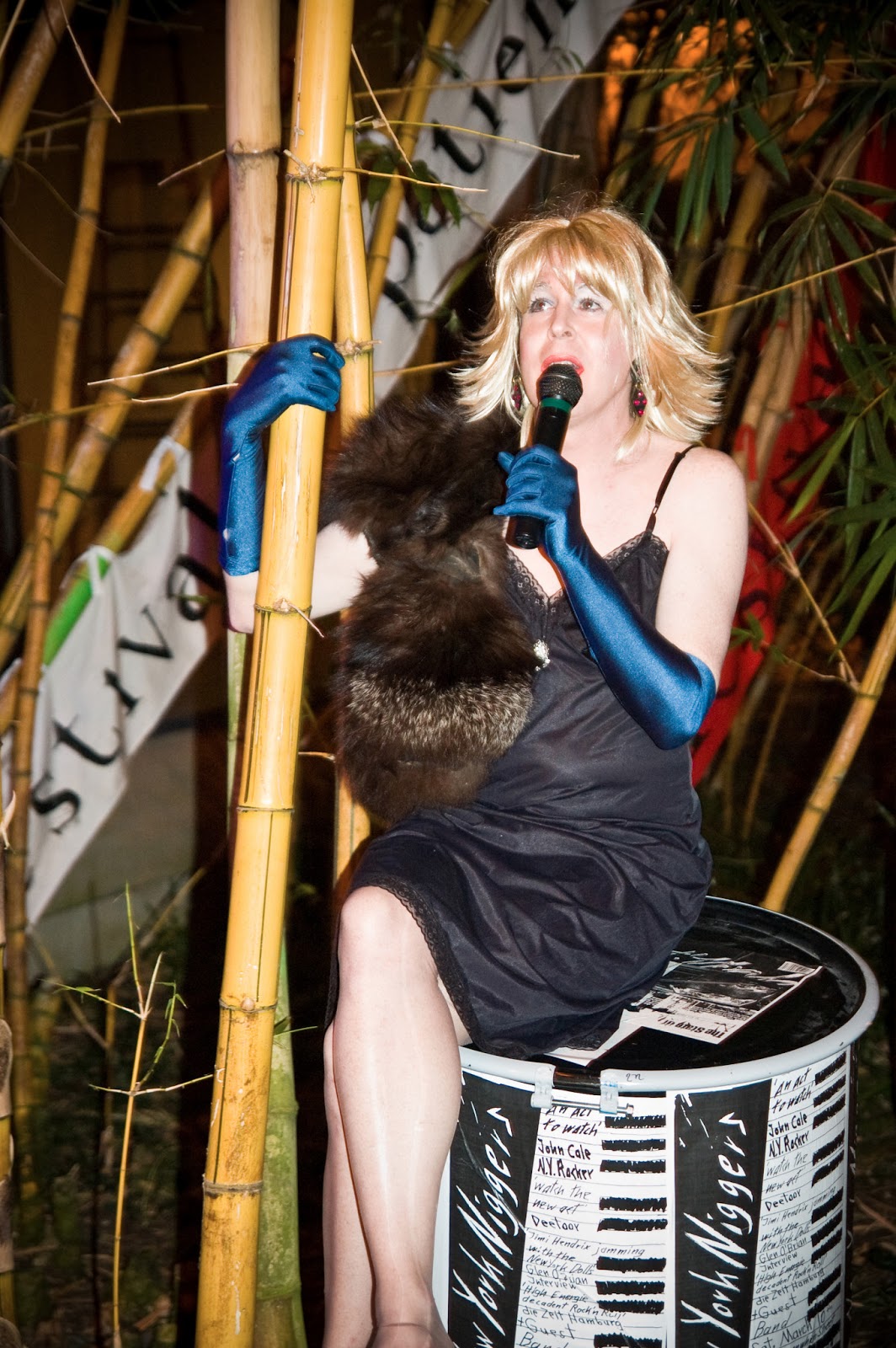
 Robert Reed as Cher doing the beat goes on. This was one of Robert's breakout performance. He subsequently did his MFA and has become a seasoned performer. Besides organizing the cabaret night he went through multiple costume changes and skits. We build a cat-walk especially for the night. At the end of the night we had all the performers, musicians and audience jamming and dancing to a life version of walk on the wild side.

                            Robert from NYC singing outside the gallery.

    A performer of Honolulu's Cherry Blossom Cabaret transformed from George Bush into Hillary      Clinton. This is before Obama was nominated.

     Dancing outside the gallery during closing night. 5 bands performned, 'For AI', 3rd floor, and Jammarek, all Honolulu, East Side Blues Band, Kauai and Box of Crayons, NYC. 3rd floor played two sets. In between sets I had to repaint the gallery, covering all the brush painting lyrics. A festival of patience indeed.

Thesis Exhibition 1

-->
Thesis Exhibition 
 University of Hawaii Manoa Campus April 2008
flags, wood block print on bamboo fabric outside the gallery

The festival of patience blog was started as support for my thesis exhibition and I stopped posting new content. Now, 5 years later, I decided to revive it and to become part of my website. It comes from the desire to share what I have been doing.


3rd floor at the opening. all dressed up (me) and all dressed down (drummer).
in back 'water' oil on linen, 3 panels 48" x 96"
15' tall wall covered with fragments of rock'n roll lyrics and quotes from the Tibetan Book of Living and Dying. painting of the Bombing of Dresden, oil on canvas 84" x 66". 7" vinyl reissue of NYN 001 "Just Like Dresden 45" (drop songs, not bombs, so to speak). oil drum with band flyers.

                                                                                                                                                                  Jeff in Patti jacket, oil on leather
Fran Powers holding up lighter, crying. Fran and Madonna Powers are old NY friends and fellow musicians and brought their band Box of Crayons, played at the opening and closing.


The thesis went off pretty much as I hoped with a great opening and performances every day and every night (except Monday), culminating Friday night with dancing to 5 bands playing. Without bragging, it can be said that the University of Hawaii Art Department hasn’t experienced a MFA thesis exhibition quite like this before or since. Special thanks go to my adviser Yida Wang and the rest of the committee Peter Chamberlain, Jaimey Hamilton and Stephen Niles, all the artists who performed throughout the week, my fellow grad-students for helping me set up the show, my taiji students who made all the local food for the opening and Galen Mew for building the stage.
 Throughout every day of the exhibition planned and spontaneous performances happened. One highlight  was the cabaret night called take a walk on the wild side. It was curated by Robert Reed and featured performers from as far away as New York.